Our Patron Saint
Saint Lawrence, Deacon and Martyr
Feast Day: August 10th
(d. 258?)
As is true for many of the saints who lived and died in the earliest centuries of the Church’s life, there is little we know with certainty about Saint Lawrence, though the fact that August 10th ranks as a feast on the liturgical calendar suggests the great esteem in which the Church has held him since the third century. It is clear that his martyrdom made a deep and lasting impression on the early Church, particularly in the city of Rome.
Lawrence was one of several Roman deacons under Pope Saint Sixtus II (whose feast day is August 7 th ). Four days after the Pope was put to death, Lawrence and four other clerics suffered martyrdom, probably during the persecution of the Emperor Valerian. Legendary details surrounding his death were known to Damasus, Prudentius, Ambrose and Augustine. The church built over his tomb became one of the seven principal churches of Rome, and a favorite destination for pilgrimages in the Eternal City.
A well-known and deeply moving legend about Lawrence has persisted from earliest times. As deacon in Rome, Lawrence was charged with responsibility for the material goods of the church, and the distribution of alms to the poor. When it became clear that Lawrence would be arrested like Pope Sixtus II, he sought out the city’s poor, its widows and orphans, and gave them all the money he had on hand, selling even the sacred vessels to increase what he could provide for them. When the prefect of Rome heard about this, he imagined that the Christians must have considerable wealth. He sent for Lawrence and reportedly said, “You Christians say we are cruel to you, but that is not what I have in mind. I am told that your priests offer in gold, that the sacred blood is offered in silver cups, that you have golden candlesticks at your evening services. Now, your doctrine says that you must render to Caesar what is his. Bring these treasures—the Emperor needs them to maintain his forces. God does not cause money to be counted: He brought none of it into the world with him—only words. Give me the money, therefore, and be rich in words.”
Lawrence replied that the Church was indeed rich. “I will show you a valuable part. But give me time to set everything in order and make an inventory.” Within three days he gathered from the city a great assembly of the sick, the poor, the blind and the lame, the leprous, the orphaned and the widowed. When the prefect arrived, Lawrence simply announced, “These are the treasure of the Church.” The Roman prefect was reportedly so enraged by Lawrence’s defiance that he told the deacon he would indeed have his wish to die—but it would be by inches. He had a great gridiron prepared, with burning coals beneath it, and ordered that Lawrence be stripped and tied to the grid. The legend concludes that after the martyr had suffered a long time, he made a famously cheerful remark to his torturers: “It is well done. Turn me over!”
Rather appropriately, Saint Lawrence is the patron of cooks, chefs, and comedians.
Our parish could hardly wish for a more fearless, unselfish, compassionate (and humorous) patron saint, a man who did not hesitate to surrender his life under the cruelest of circumstances out of love for the One to whom he had given his heart, and who had obviously come to understand his Master’s teaching that the greatest of treasures is to be found in the least of our sisters and brothers.
Adapted from Saint of the Day, St. Anthony Messenger Press, Cincinnati, OH, 2009.
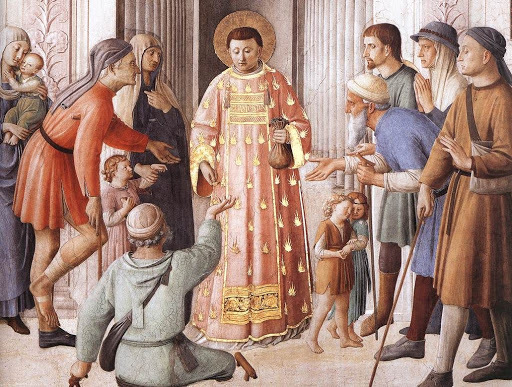
"St. Lawrence Distributing Alms" by Fra Angelico